
In linguistics, “false friends” are words that look the same in two languages but mean something different. In education, assessment objectives have the same problem.
“Analysis.” “Evaluation.” “Application.” Our students hear these words in different subjects. They look the same. They’re not.
Lily is new to Economics. She needs to learn what each word means so she can showcase them in her answers in the right proportions.
Sam does Economics, English and History. When I say “analysis,” he’s carrying three different definitions in his head. Analysis in an Economics essay is markedly different to analysis in an English Literature essay or a History source question. Same word. Different skill. Different examiner expectations. False friends.
Sophie does Economics, RS and English. When I say “evaluation,” she’s thinking about it through three completely different lenses. What counts as strong evaluation in RS is not what counts in an Economics essay.
Now multiply that across a class of twenty students, each with a different combination of subjects. Every one of them hears the same words. None of them hear the same meaning.
As a tutor, this changes how I target my guidance. If I know what a student is hearing from their other teachers, I can reframe my advice to meet them where they are — and stop accidentally confusing them with language that means something different in their other subjects.
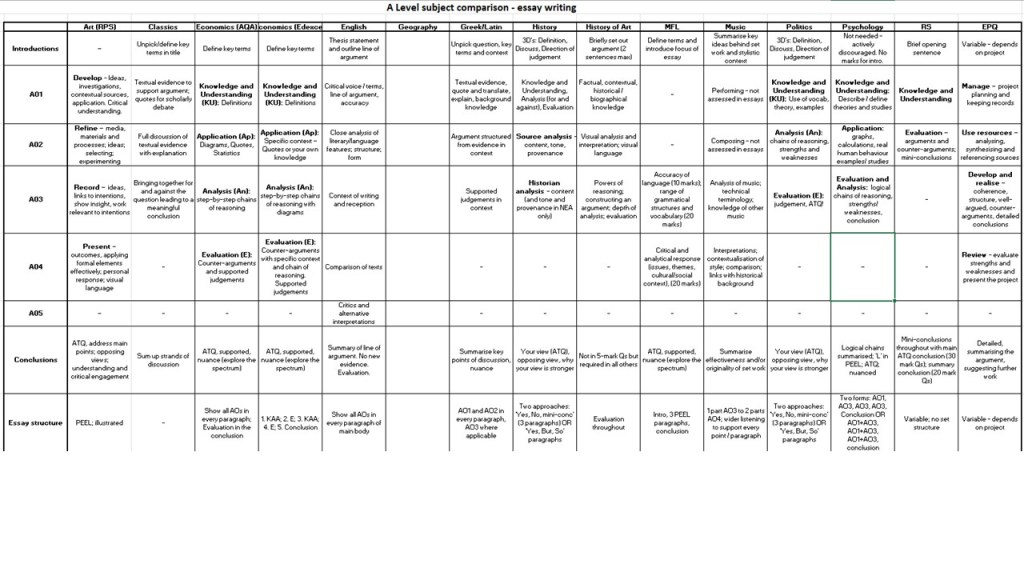
The grid does three things:
First, it compares assessment objective guidance across different subjects — contributed by brilliant teachers from each discipline. It’s a side-by-side view of what “analysis,” “evaluation” and “application” actually mean in each one. Thank you so much to those who contributed.
Second, it highlights how different the guidance is even within the same subject. AQA Economics and Edexcel Economics have markedly different expectations for how students should structure their work. If you’re tutoring across exam boards, this matters.
Third — and this is the part I’m most proud of — there’s a second sheet with drop-down boxes. Pick any student’s three or four subjects, and it auto-populates a personalised side-by-side comparison they can use as a reference.
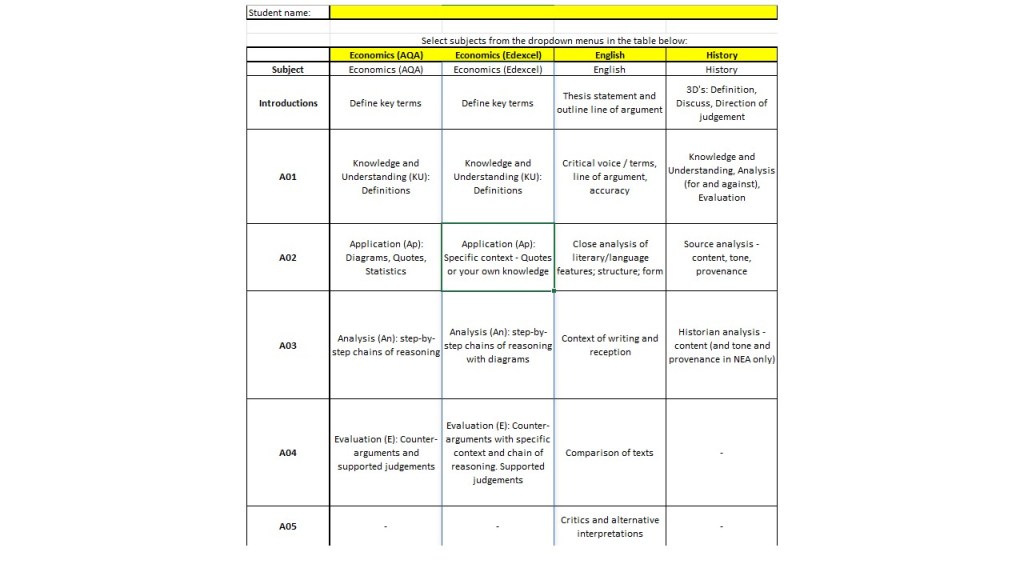
Download it below. Adapt it. Improve it. Share it. It’s not the finished article — maybe it never will be. But I believe it can have great value in the right hands.
If you teach a subject that’s missing, I’d love your contribution. The more subjects we map out, the fewer false friends our students have to navigate.
Enjoy!
 econ amazing